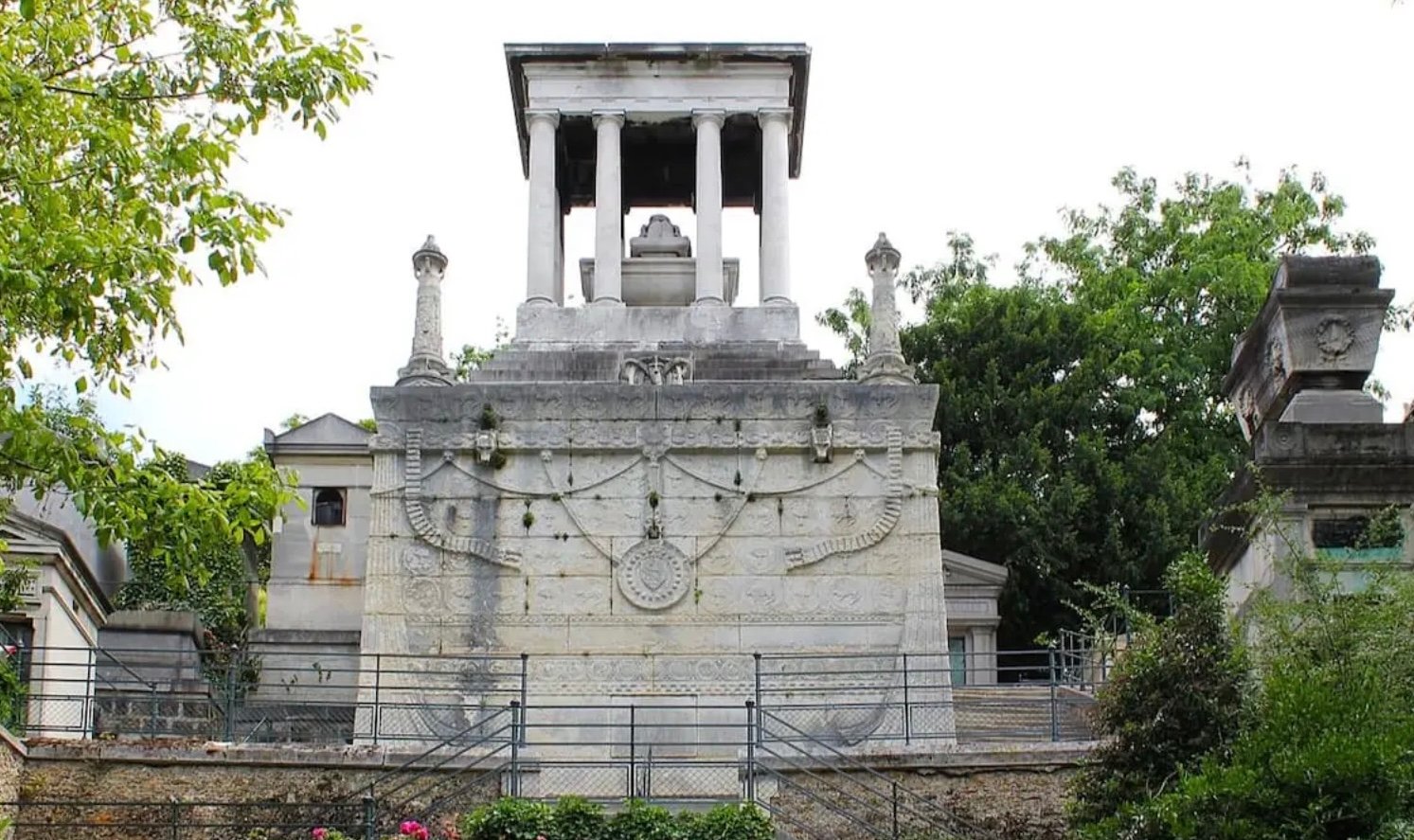
The Demidoff Mausoleum in Père Lachaise Cemetery in Paris was originally constructed in April, 1818 for Elisabeth Alexandrovna, née Stroganova, de Demidoff (1779-1818). Baroness Demidoff died in her beloved Paris on 8 April 1818, aged only 40, following a brief illness. It was her estranged husband, Nikolai Nikitich Demidoff (1773-1928), who purchased the initial 12 square meter plot in what is today Section 39 of the cemetery. He also purchased an antique-style, white marble sarcophagus, that was made in Carrara, Italy. The sarcophagus was placed on a stylobate supporting ten Doric columns made of the same Carrara marble.
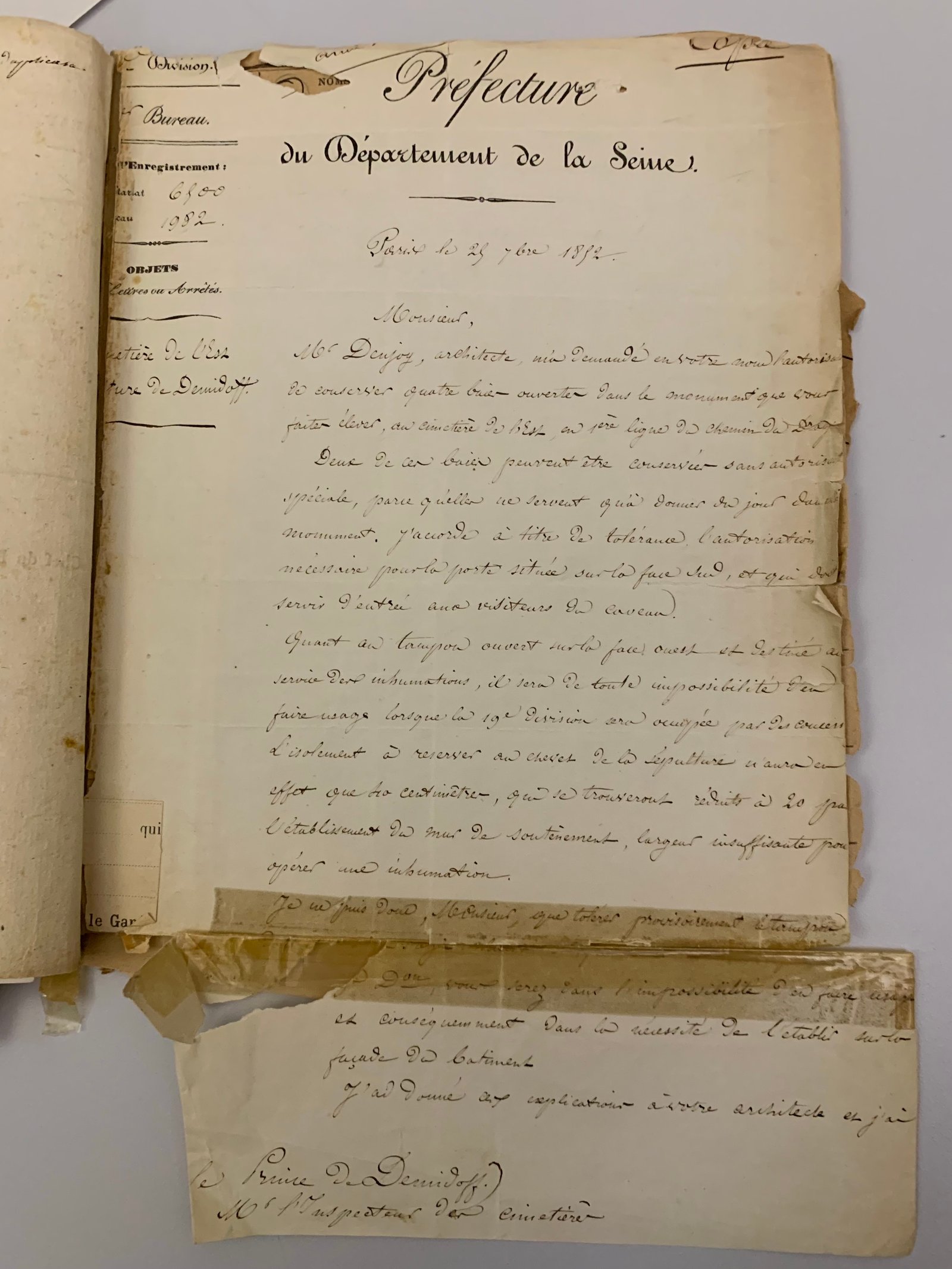
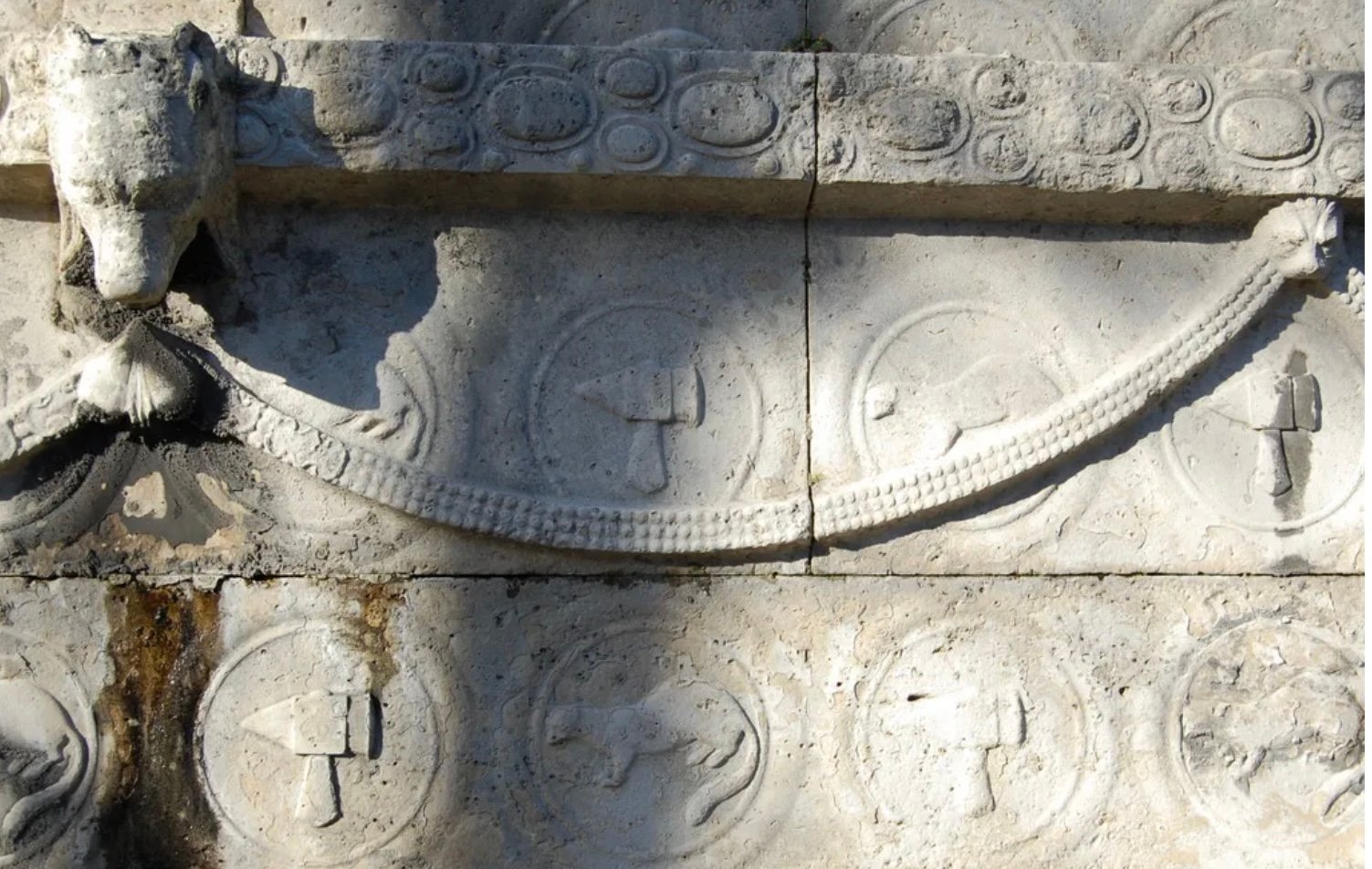
However, the popularity of Paris's first modern cemetery grew in the ensuing decades that led to severe overcrowding. The proliferation of tombstones left the Demidoff Mausoleum practically hidden from public view. It was for this reason that, in early 1852, Anatole Demidoff, Baroness Demidoff's second son, contacted Jean-Charles Danjoy (1806-1862), an expert in the restoration of historical monuments, to design a new and enlarged monument to be more prominently positioned. The original mausoleum was carefully dismantled and then reassembled stone by stone atop a hill in the 19th section of the 'Chemin du Dragon' cemetery area. The original sarcophagus was placed on a massive plinth and the exterior decorated with symbols of the Stroganoff family that included the sable and the wolf. The Demidoff mausoleum today is the largest and most imposing of all the many monuments of the cemetery.
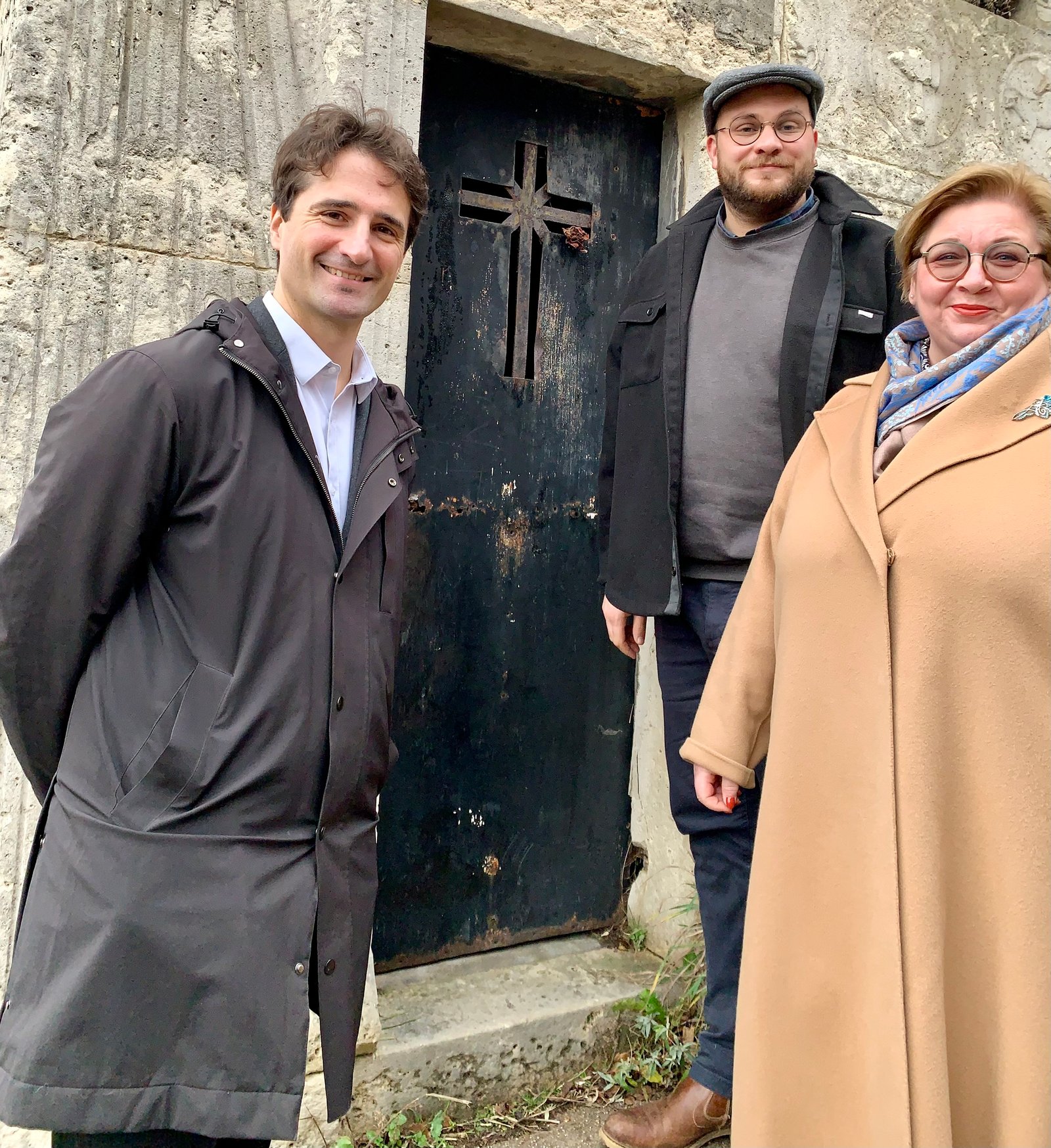
However, the current status of "plot 65 PA 1818", as it is formally designated in the cemetery records, leaves a number of open questions. It was for this reason, that a meeting was organised in Paris with Mr. Benoit Gallot, the director of Père Lachaise Cemetery, on Monday morning, 8 December 2025. Joining the author was Mrs. Ella Romanova, who, during these last years, has kindly and generously assisted the European Demidoff Association whenever requests arise in Paris that involve the Demidoff Mausoluem. Mr. Gallot, in turn, was joined by Dr. Arnaud Schoonheere, the Cemetery's Heritage Curator.
The primary concern was with the apparent lax management of the historical records by previous administrators of Père Lachaise Cemetery. There did not appear to be any documented record showing the identity of each direct descendant of Baroness Demidoff who would be the rightful owner. It is clear that ownership should have passed to the sons of Baroness Demidoff, Paul Nikolaievitch (1798-1840) and Anatole Nikolaievitch (1813-1870). Following Anatole's passing in 1870, ownership should have passed to his universal heir, Paul Pavlovitch Demidoff (1839-1885), and then to Paul's eldest son, Elim Pavlovitch Demidoff (1868-1943) and to his siblings. The direct descendants of the brothers and sisters of Prince Elim Demidoff should then have featured in the ownership chain.
It is of concern that this ownership chain was not honoured. This is based on the findings of René G. Pouliot, a Canadian national, who married the granddaughter of Anatole Pavlovitch Demidoff (1874-1943). In April, 1999, Pouliot shared with the author correspondence dated 7 June 1983 that he had received from Alain Renouf, Deputy Consul, Consulate General of France based in Montreal, in regards to the ownership chain of the mausoleum. The letter stated that "none of the beneficiaries had asserted their rights from the time the concession was originally granted in 1818 until 1972, when Mr. Pavel Demidoff became a co-owner in undivided possession with other heirs, who eventually asserted their rights". This is hard to believe. Moreover, the Mr. Pavel Demidoff (1906-1988), in question, whom Pouliot had met in 1983 during a visit to the Demidoff Mausoleum, was not a direct descendant of Baroness Demidoff. Instead, he pertained to the distinguished Grigory Akinfeevich Demidov (1715-1761) branch of the Demidoff's. In his correspondence to me, Pouliot made it clear that it would have been highly irregular for Elim Demidoff, 3rd Prince of San Donato, to pass his ownership rights to a cousin given that his siblings and their descendants clearly remained in the ownership chain. At long last, this oversight was addressed with current ownership rights now passed to the author, a direct descendant of Baroness Demidoff, and with other direct descendants to be contacted in due course to ensure that each of them are given the opportunity to assert their proper ownership rights.
Another concern involves the large number of non-Demidoff family members interred at the manusoleum. The original concession stated that these burial plots were reserved for direct descendants of Baroness Demidoff. However, a review of the records show that only 9 of the 34 individuals buried held a direct, or even an indirect connection, to the 'Tuscan' branch of the Demidoff's. In this regard, it was fascinating to view for the first time original documentation that showed that it was Anatole Demidoff, or, in one case, his legally authorised secretary, Octave Jaunez-Sponville, who directly authorised the burial of 7 individuals at the mausoleum from 1834 to 1840. The identity of these individuals have yet to be fully studied. However, preliminary findings show that Anatole Demidoff's approval for the burial of Mr. Ivan Alexandrovitch Narichkin (1761-1840), that was granted on 4 March 1840, relates to the fact that he was the husband of Catherine Stroganova (1769-1844), an extended family member.
The original documents also showed that in May, 1909, Helen Pavlovna Demidoff, Princess of San Donato (1884-1959) authorised for burial her brother, Paul Pavlovitch Demidoff, Prince of San Donato (1879-1909). This was an unexpected find since it resonates with the more recent transfer in 1999 of the bodily remains of the same Princess Helen Pavlovna from Allori Cemetery in Florence to the Demidoff Mausoleum in Paris where she now rests in peace with other immediate family members including her brother.
Another interesting find involved those names found in the records who authorised repairs and 'installations of placques' at the mausoluem. These showed the engagement of the rightful descendants of Baroness Demidoff that included Prince Paul of Yugoslavia (1893-1976) in May, 1967 and Princess Maria Abamelek-Lazareva (1877-1955) in December, 1912. Also of interest, although an engaging open mystery, is the request, dating to 20 Novembre 1965, for the installation of a 'white marble placque', by Mrs. Marie Ianouchevsky née Belevsky-Zhukovsky (1901-1996) for Maria Petrovna Belevskaya-Zhukovskaya née Princess Trubetskaya (1872–1954). In fact, the requested placque was for the sister of Helen Petrovna Demidova, Princess of San Donato née Trubetskaya (1853–1917), wife of Prince Paul, 2nd Prince of San Donato. It would be interesting to discover greater detail on the interesting individuals involved with this placque.
The records further are not clear on the number of compartments originally constructed, versus those that are occupied, and so the number remaining. The records show inconsistency in regards to the number of those marked to be available following particular burials. According to the burial records, 34 individuals are currently interred, based on total available compartments of 42, which would leave 8 still available. However, it is important to secure a definitive record of the status since a possibility exists that 'tiers' of compartments may be involved.
Lastly, it is important for the Demidoff Mausoleum to feature at the highest level of protection as a historical monument of France. As such, we are in process of submitting an application for classification of the mausoleum as a historic monument in addition to its existing classification as a historic monument under the Père Lachaise protection order.
In the end, solid progress was made in addressing the various open issues involving the Demidoff Mausoleum in Paris. Most important, we are highly confident in regards to the professional competence, dedication, and passion of the new directors of the cemetery, Mr. Benoit Gallot and Dr. Arnaud Schoonheere. In collaboration with Mrs. Ella Romanova, we look forward to ensuring that this important and imposing monument withstands the test of time and remains accessible to future direct descendants of Baroness Demidoff as well as for viewing by the public in general.